|
[ Section Vaginatae page. ] [ Amanita Studies home. ] [ Keys & Checklist/Picturebooks ] Amanita sinicoflava Tulloss"Mandarin Yellow Ringless Amanita"
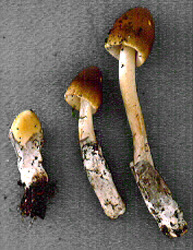
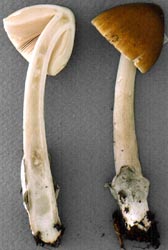
BRIEF DESCRIPTION: Amanita sinicoflava has a Chinese yellow or "curry powder colored" or yellow-olivaceous or olive-tan cap that is 25 - 70 mm wide. Striations run inward from the cap edge for about 40% of the radius. Warts or patches of pallid to grayish volva are often left on the cap, but can be washed off easily by rain. This mushroom has a whitish, exannulate stem (60 - 135 x 4 - 12 mm) decorated with somewhat darker fibrils. The volval remnants are saccate and submembranous and becoming progressively grayer with age beginning from the top of the sac and working downward. The gills of this species turn grayer as the mushroom ages. The very plentiful short gills are truncate. The spores measure (8.0-) 9.1 - 12.1 (-15.4) x (7.0-) 8.4 - 11.5 (-15.4) µm and are globose to subglobose (very rarely broadly ellipsoid) and inamyloid. Clamps are absent from bases of basidia. The species occurs with oak, beech, and diverse conifers. It is distributed widely in the northeastern and north central United States and, probably, in southeastern Canada--fruiting from late June to October. Prior to its description, this species was often determined as "Amanita fulva" and might be found in herbaria under that name. Among taxa that are most similar macroscopically are A. mortenii Knudsen & Borgen, A. olivaceogrisea Kalaméés, and A. submembranacea (Bon) Gröger. -- R. E. Tulloss. Photos: R. E. Tulloss [ Section Vaginatae page. ] [ Amanita Studies home. ] [ Keys & Checklist/Picturebooks ] Last changed 6 July 2008. |