|
[ Section Vaginatae page. ] [ Amanita Studies home. ] [ Keys & Checklist/Picturebooks ] Amanita olivaceogrisea Kalaméés"Olive-Gray Ringless Amanita"
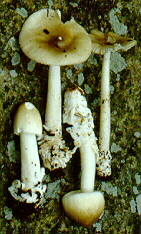
Technical description (t.b.d.) BRIEF DESCRIPTION: Amanita olivaceogrisea has a cap 30 - 60 mm wide, olive-gray to ochraceous gray to brown-gray, with a sulcate margin and, sometimes, with large warts that are persistent, cottony white at first, but become gray to ochraceous gray. The gills are free, crowded, and white. The stem is 50 - 90 x 5 - 10 mm, exannulate, white, and often decorated with dense gray to olive-gray fibrils. The submembranous volva of this species is saccate at first, but may break up into large patches distributed on the lower part of the stipe. The volva has a tendency to become gray from the upper edge down. The spores measure (8.5-) 9.2 - 13.2 (-16.6) x (8.1-) 8.4 - 12.1 (-15.0) µm and are globose to subglobose to broadly ellipsoid and inamyloid. Clamps are not observed at bases of basidia. Amanita olivaceogrisea appears to be limited to wet soils in association with alder or hazel. Amanita olivaceogrisea is known from England, Estonia, France, Latvia, Sweden, and probably will be found in Norway. Among species somewhat similar in habit and color are A. submembranacea
(Bon) Gröger of Europe and A. sinicoflava Tulloss of
North America. Photo courtesy of Dr. Cornelis Bas (Estonia). [ Section Vaginatae page. ] [ Amanita Studies home. ] [ Keys & Checklist/Picturebooks ] Last changed 21 August 2008. |