[ Section Amidella page. ] [ Amanita Studies home. ] [ Keys & Checklist/Picturebooks ]
Amanita neoovoidea Hongo"East Asian Egg Amidella"
Technical description (t.b.d.)
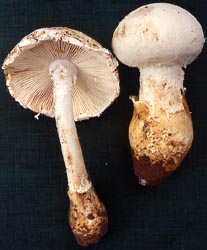
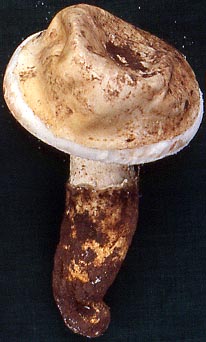
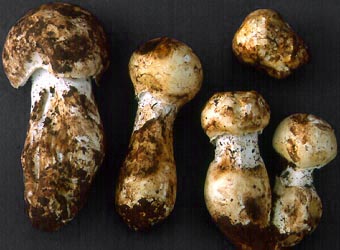
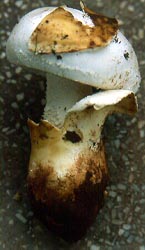
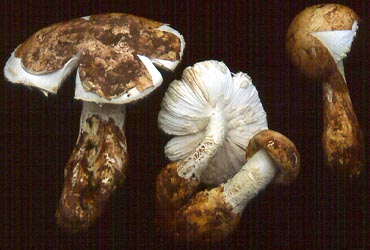
BRIEF DESCRIPTION: Like many species of Amanita section Amidella, A. neoovoidea has more than one distinct volval layer. Below the firm, yellowish or tannish membranous layer (commonly left on the cap as a calyptra) is a powdery layer.
The cap is 75 - 130+ mm wide, white or off-white becoming golden blonde in age, and hemispheric at first becoming planoconvex or depressed in age. The flesh is unchanging when cut or bruised.
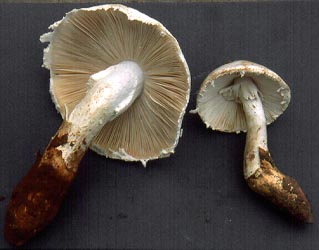
The gills are pale cream to white, sometimes with a faint rosy tint, free with a decurrent line on the upper stem, and up to 7 - 10 mm broad. Short gills are frequent and rounded attenuate.
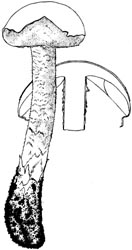
The stipe is 110 - 130 x 12 - 15 mm, white, becoming sordid on handling, and flocculose or floccose-squamulose. Its flesh is white. A white annulus is present and is apical to superior, floccose-subfelted, friable, and often disappearing. The base of the stem is often inserted rather deeply in the soil (sometimes radicating). The volva is saccate, membranous, and colored as on the cap or more orangish. The appearance of a bulb is due to the robustness of the volval sack.
The odor of this species is reportedly penetrating, but not unpleasant; and the taste is mild.
The spores measure (5.8-) 6.8 - 9.8 (-12.0) x (4.2-) 4.8 - 6.5 (-7.5) µm and are amyloid and broadly ellipsoid to ellipsoid (occasionally elongate, rarely cylindric). Clamps are not present at bases of basidia.
This species is edible and eaten in a variety of preparations in Japan (for example, as tempura or in soups). Because of this fact, reports that it contains the same kidney toxin as Amanita smithiana Bas (section Lepidella) may require reinvestigation.
The type species of section Amidella, A. volvata (Peck) Lloyd, as well as other North American, European, and east Asian taxa (e.g., A. avellaneosquamosa (S. Imai) S. Imai and A. clarisquamosa (S. Imai) E.-J. Gilbert) of section Amidella, have flesh that will often turn pink when cut or bruised. Moreover, old wounds and powdery remnants of the volval often become brown or reddish brown in age in these species. Amanita neoovoidea lacks these two characters. A distinctive odor is also not commonly reported for taxa of the section. The species most similar to A. neoovoidea are A. ovoidea (Bull. : Fr.) Link and A. proxima Dumée.
The species was originally described from Japan. It is also known from China and Nepal.
Yang (1997) provides the most recent taxonomic description of this species. -- R. E. Tulloss
Photos: David Arora (2nd through 4th rows, Yunnan Province, China); Zhu L. Yang (1st row, southwestern China)
Pen and ink drawing: Dr. Tsuguo Hongo (Japan)
[ Section Amidella page. ] [ Amanita Studies home. ] [ Keys & Checklist/Picturebooks ]
Last change 10 October 2009.
This page is maintained by R. E. Tulloss
Copyright 2003, 2004, 2005, 2009 by Rodham E. Tulloss.
Photographs copyright 2003 by David Arora.
Photographs copyright 2005 by Dr. Z. L. Yang.
Pen and ink drawing copyright 1992 Tsuguo Hongo.