|
[ Section Lepidella page. ]
[ Amanita Studies home. ]
[ Keys & Checklist/Picturebooks ] "Newcomer Lepidella"
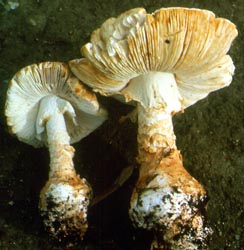
Technical description (t.b.d.) BRIEF DESCRIPTION: The cap of Amanita advena is 85 - 120 mm wide, viscid when moist, broadly convex to slightly concave at maturity, dry, becoming areolate, appendiculate, decurved at first, becoming rimose, with a nonstriate margin. The cap is white to light buff when young, becoming tinged with cinnamon in time, with no other discoloring. The flesh is whitish buff. The volva is white at first, then brown, breaking into flattened to slightly crumpent, large warts to small patches, at times in concentric rings. The gills are free, close, light cream, becoming dingy ochraceous in age near the cap margin, strongly fimbriate. The short gills are numerous. The stem is 110 - 130 x 15 - 25 mm, buff, becoming cinnamon abose the basal bulb, narrowing upward, membranous to submembranous, striate above, smooth below. The volva is white at first, browing, and in a series of obscure rings from a point slightly above the top of the bulb to a point below the broadest point of the bulb. The spores measure (8.5-) 9 - 12.5 (-14.0) x (6.5-) 7.0 - 9.5 (-10.2) µm and are broadly ellipsoid to ellipsoid (occasionally subglobose, infrequently elongate) and amyloid. Clamps are present at bases of basidia. Known only in association with oak in cloud forest of Andean Colombia (from which the species was originally described) and Costa Rica (where it appears to be more common, especially in the Cordillera Talamanca). -- R. E. Tulloss Photo: Dr. Clark L. Ovrebo (Colombia).
[ Section Lepidella page. ]
[ Amanita Studies home. ]
[ Keys & Checklist/Picturebooks ] Last changed 1 October 2009. |